
Each material, its own technique
No single method suits everything. Steam works wonders on grout but harms parquet; high pressure cleans concrete but erodes joints and roof tiles. Here is how we decide.
Material guide
Pick a material to see the techniques we recommend and the ones we steer clear of.
Glass
- Techniques we recommend
- Classic window cleaning, Pure water & water-fed poles
- Best avoided
- Scouring pads, razor blades on coated glass, cleaning in direct sunlight.
- Our tip
- Pure water outside, the traditional method inside.
Bluestone & natural stone
- Techniques we recommend
- Microfibre & colour-coded zones, Scrubber-dryer, Low pressure & softwash
- Best avoided
- Acidic products (vinegar, descalers, cement-film removers) and anything abrasive.
- Our tip
- pH-neutral cleaners; a protective impregnation reduces staining.
Parquet & wood
- Techniques we recommend
- Microfibre & colour-coded zones
- Best avoided
- Steam, excess water and harsh products.
- Our tip
- Care depends on the finish: soap or oil for oiled wood, a neutral cleaner for lacquered floors.
Vinyl & linoleum
- Techniques we recommend
- Microfibre & colour-coded zones, Scrubber-dryer, Single-disc machine, stripping & protective finish
- Best avoided
- Strongly alkaline products on linoleum, and solvents.
- Our tip
- Machine scrubbing, plus a protective coat from time to time.
Concrete & resin
- Techniques we recommend
- Scrubber-dryer, Degreasing, High pressure (used sparingly)
- Best avoided
- Acid on bare, untreated concrete.
- Our tip
- A scrubber-dryer, with a degreaser for oil stains.
Tiles & grout
- Techniques we recommend
- Dry steam, Scrubber-dryer, Microfibre & colour-coded zones
- Best avoided
- Acid close to any natural stone bordering the tiles.
- Our tip
- Steam for the grout; cement film removed only with a product made for ceramics.
Synthetic carpet
- Techniques we recommend
- Encapsulation, Spray extraction
- Best avoided
- Too much water and too little drying time.
- Our tip
- Encapsulation in between, spray extraction at regular intervals.
Wool & hand-knotted rugs
- Techniques we recommend
- Encapsulation
- Best avoided
- Hot steam, excess water and high-pH products.
- Our tip
- Check colourfastness first; valuable pieces are sometimes best entrusted to a specialist workshop.
Stainless steel
- Techniques we recommend
- Degreasing, Microfibre & colour-coded zones, Dry steam
- Best avoided
- Chlorine-based products and steel wool (rust marks, pitting).
- Our tip
- Degrease, then finish following the grain.
Brick & facades
- Techniques we recommend
- Low pressure & softwash, Moss removal & protection
- Best avoided
- High pressure on joints and soft brick.
- Our tip
- Low pressure with a suitable product, after a test patch.
Roof tiles & slates
- Techniques we recommend
- Low pressure & softwash, Moss removal & protection
- Best avoided
- High pressure: it damages the surface and can drive water under the tiles.
- Our tip
- Cleaned by hand or at low pressure, then treated against moss.
Solar panels
- Techniques we recommend
- Pure water & water-fed poles
- Best avoided
- High pressure, abrasives, and detergents that leave a film.
- Our tip
- Pure water and a soft brush, preferably while the panels are cool.
Our techniques
Microfibre & colour-coded zones
Microfibre cloths and mops trap the finest dirt using very little water or product. Each zone (washrooms, kitchen, offices) has its own colour, so dirt is never carried from one room to the next.
- Ideal for
- Routine cleaning of nearly every hard surface, Spaces where cross-contamination must be prevented
- Take care with
- Wiping dry on dusty glass or high-gloss finishes: dust them off first
Dry steam
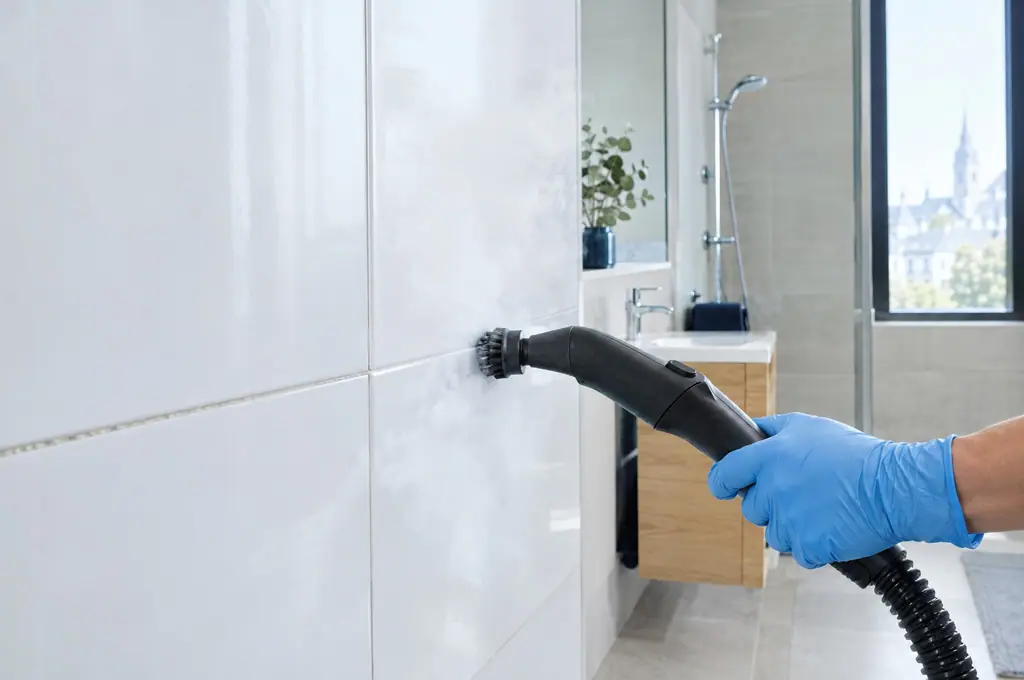
Very hot steam carrying little moisture dissolves grease and deposits with minimal product. Ideal for grout, washrooms, stainless steel and kitchens.
- Ideal for
- Tiles and grout, Bathrooms, toilets and kitchens, Vehicle interiors
- Take care with
- Parquet and lacquered or untreated wood, Wool, silk and fragile fabrics, Electronic equipment and glued seams
Classic window cleaning
Washer, squeegee and chamois leather: the time-honoured method for indoor and outdoor glass within safe reach, precise right into the corners.
- Ideal for
- Inside glazing and shop windows, Windows with fine detailing or stained glass
- Take care with
- Windows high up without safe access
Pure water & water-fed poles
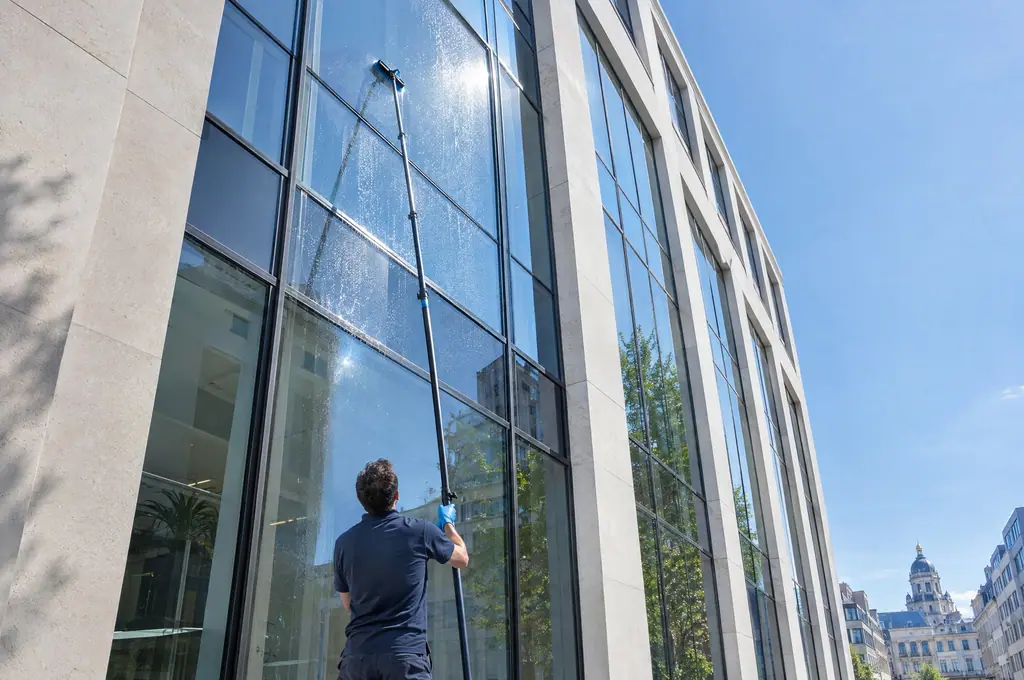
Demineralised water dries without leaving marks. Fed through a telescopic pole, it lets us clean windows, frames and solar panels several storeys up while staying on the ground.
- Ideal for
- Exterior windows and frames, Solar panels, Skylights and conservatories
- Take care with
- Very greasy glass (needs pre-treatment), Interior glazing
Scrubber-dryer
Scrubs, rinses and collects the dirty water in one go. Fast on large hard floors, and safe, as the floor is dry almost straight away.
- Ideal for
- Offices, corridors and shops, Warehouses, car parks and industrial sites
- Take care with
- Parquet or delicate natural stone without the right pad
Single-disc machine, stripping & protective finish
Fitted with the right pad, a single-disc machine can clean, strip or polish a floor. On vinyl and linoleum, we finish with a protective coating.
- Ideal for
- Vinyl, PVC and linoleum, Tiles and certain natural stones
- Take care with
- Highly alkaline strippers on linoleum, Acid-based products on limestone or marble
Spray extraction
A cleaning solution is injected into the carpet and immediately drawn back out, taking the dirt with it. This is the method for a deep clean.
- Ideal for
- Synthetic wall-to-wall carpet, Carpet tiles with heavy soiling, Upholstery whose care label allows it
- Take care with
- Wool or hand-knotted rugs with heat or a lot of water, Rooms that can’t be left to dry
Encapsulation
A product locks the dirt into crystals, which are picked up at the next vacuuming. Very little moisture is used, so the carpet can be walked on again almost immediately.
- Ideal for
- In-between care of office carpets, Rooms that must be back in use quickly
- Take care with
- Stubborn stains or deep-seated dirt (spray extraction is better)
Low pressure & softwash
A suitable product and water applied at low pressure, sometimes warm. The product does the work, not the force of the jet.
- Ideal for
- Brick, plaster and render, Roof tiles, Natural stone patios
- Take care with
- Products not first tested on the material, Working in frosty weather
High pressure (used sparingly)
High pressure is powerful, but never harmless. We keep it for materials that can take it, with the right distance and pressure.
- Ideal for
- Concrete and hard paving, Metal parts and containers
- Take care with
- Soft brick, joints and lime mortar, Wood, roof tiles and solar panels
Degreasing
Alkaline cleaners break down grease on kitchens, filters, machinery and floors. We adapt the strength to each surface and rinse thoroughly afterwards.
- Ideal for
- Kitchens, extractor hoods and filters, Workshop floors, Stainless steel
- Take care with
- Strong alkaline products on aluminium and lacquered surfaces, Linoleum
Contact disinfection
We clean first, then disinfect with an authorised biocide, respecting the required contact time. The focus is on touch points and high-risk areas.
- Ideal for
- Washrooms, treatment rooms and sports halls, Door handles, counters and keyboards
- Take care with
- Disinfecting a surface that hasn’t been cleaned, Mixing products
Disinfection by fogging
An authorised disinfectant is released as a fine mist into an empty, closed room. It complements cleaning by hand; it never replaces it.
- Ideal for
- Empty rooms after contamination, Vehicles and small rooms
- Take care with
- Rooms where people are present, Delicate electronics without prior advice
HEPA vacuuming
Industrial vacuum cleaners fitted with a HEPA filter capture fine building dust instead of blowing it back into the room.
- Ideal for
- Site and pre-handover cleaning, After a fire or renovation works
- Take care with
- Wet slurry without the appropriate equipment
Moss removal & protection
We remove moss and algae, then apply an anti-moss treatment or water repellent that slows regrowth.
- Ideal for
- Roofs, driveways and patios, Facades turning green
- Take care with
- Treating just before rain, Products harmful to plants or watercourses
Let’s talk about your space.
Tell us what you need and receive a tailored quote, free and with no obligation. Rather talk? Leave your number and we will call you back.